 Image 1 of 4
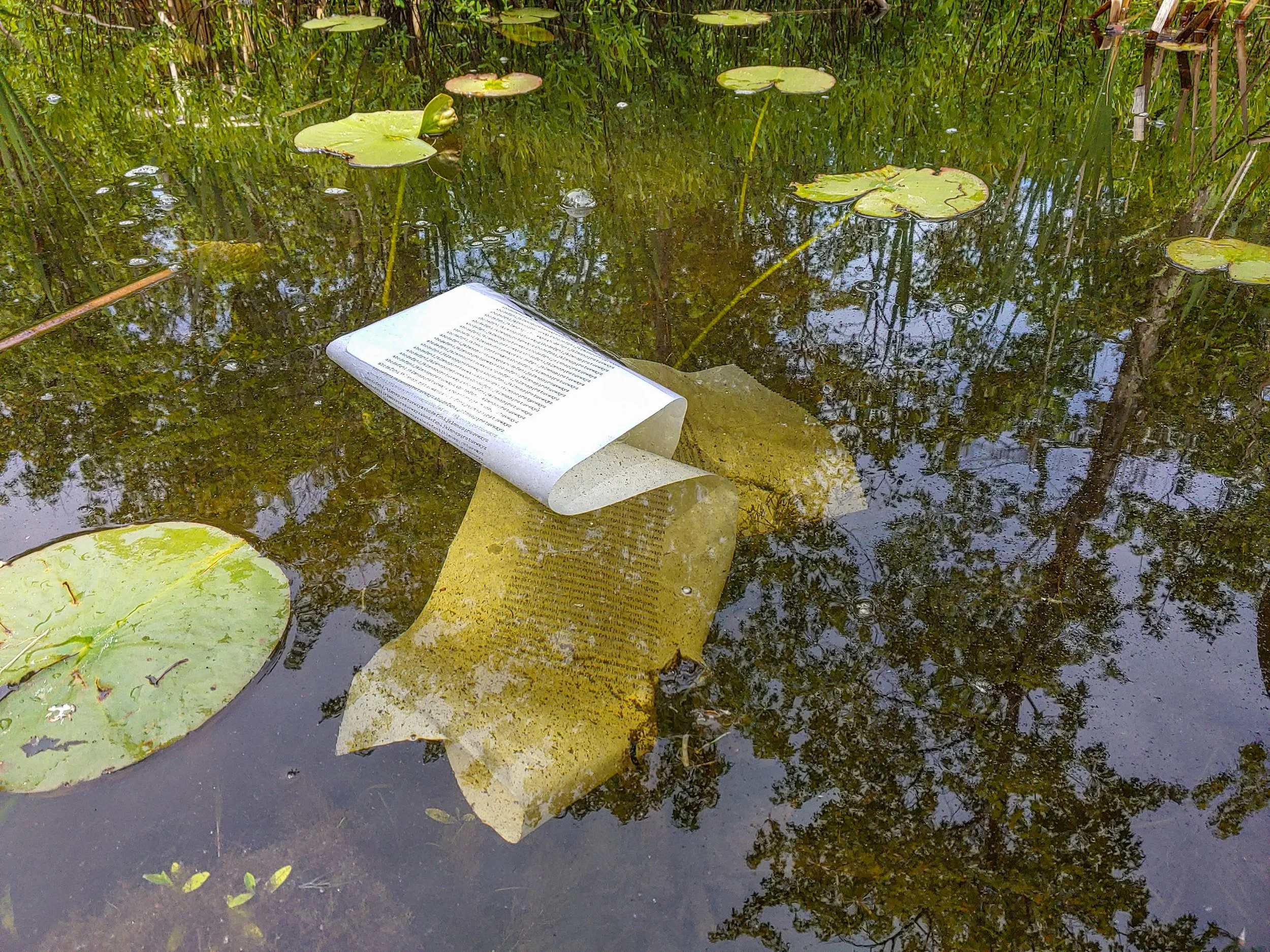 Image 2 of 4
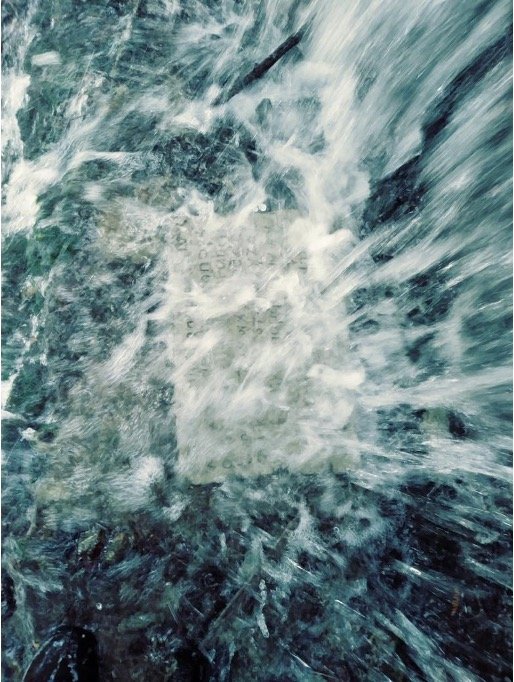 Image 3 of 4
 Image 4 of 4
“The limits of my language are the limits of my world.” – Ludwig Wittgenstein
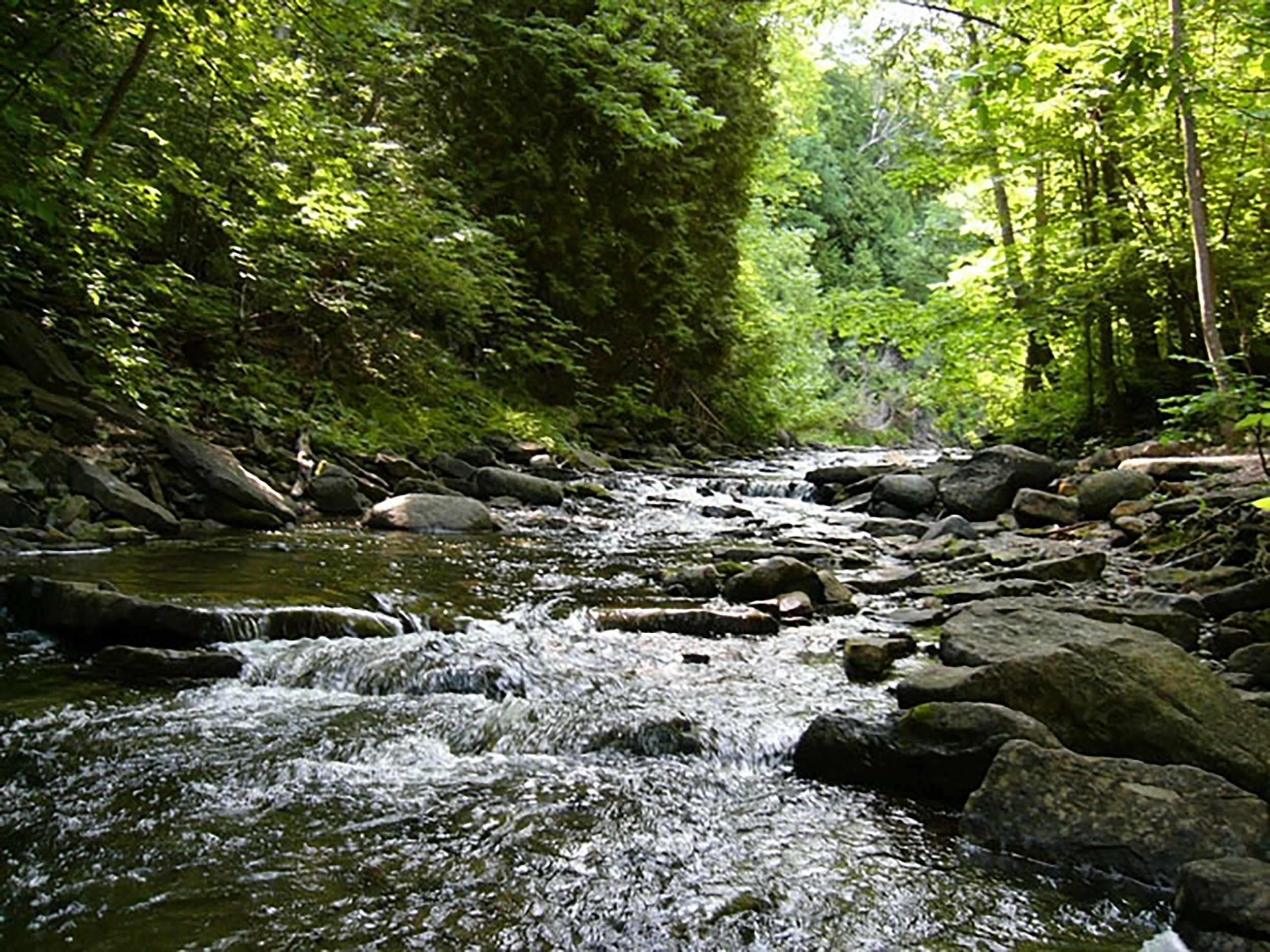
A mudlark is a person who scavenges for treasure in the mud and banks alongside rivers. Writers, poets, musicians, visual artists, naturalists and anyone hoping to shift ecological relations, are invited to join me as we spend slow time with the Kagawong River on Manitoulin Island, responding to and listening with her and the various agents that cohabitate within and cocreate this aquatic ecosystem. Rivers change season to season, moment by moment; therefore, what we define as the ‘bank’ of a river also shifts. Water morphs and transforms from vapour to ice. We will dip into this shifting of states, this porousness, to transgress perceived boundaries – ecological, linguistic, artistic. Our capacity to understand River and her languages is shaped by the boundaries, claims, and histories of our human languages, in particular colonizing ones like English – these too, we will transgress, finding new words and shaping different grammars, sounding ourselves within the middle space between river languages and human languages: muddling, vaporizing, de-composing, and running over the banks of English in the process, in an effort to find new ways of being in relation with River, and ourselves. We will explore listening in embodied ways, and experiment with language and form. Each day will be guided by different questions, provocations, experiments and lively conversations. Participants will have time to create and share their experiments. Participants may also expand the workshop by working with me independently to shape a project or receive feedback on works-in-progress.
We will meet at the River each day from 12-4, beginning with a shared lunch and conversation. BYOB lunch. Similarly, all other meals are the responsibility of each participant.
Mornings will be for self-directed independent studio time (from any location, ie: your home or rental or self-directed at the River for example).
We will meet Rain & Shine. There are a couple of covered meeting spots we can use if needed to have a break from weather, to eat and to gather. There are washrooms available at two locations near the trailheads.
$85/session (1-4 days) OR $375 for all five sessions
Private coaching: $75/hourParticipants may join any or all sessions; each session will be designed to flow interchangeably and independently as well.
In the drop down menu, select the single day or days you’d like to attend (1-4), or select the full session (5 sessions).
Accommodation will be organized independently by each participant; however, I will connect participants looking to share accommodations. There are BnBs (VRBO, AirBnB), tenting hosts, motels, hotels and resorts throughout Manitoulin. It is advisable to book early.
Island wide accommodations can be found on Trip Advisor and via FB page Manitoulin Short Term Vacation & Cottage Rentals. Accommodation in the west end (Kagawong and further west) can be found on Visit West Manitoulin. Tenting sites are available through Norm’s Park on Lake Kagawong. There are a number of cabin rentals on Lake Mindemoya/M’Chigeeng First Nation.
We will be meeting in Kagawong, so consider driving distance. Mindemoya is approximately 20 minutes from Kagawong; Gore Bay is 15. M’Chigeeng is 15. Little Current is 35 minutes.
Note: There is no public transportation on Manitoulin. The closest bus service will deliver you to Espanola (85 minute drive from Kagawong). Other than carpooling with a co-participant, you will need a vehicle. For avid cyclists, you can cross on the ferry from Tobermory and cycle on the Island.
The approach embraces the following: Slow work. Slow listening. Embodied approaches. Process. Interdisciplinarity.
As a facilitator my approach is to design workshops that have a proposed structure, but which flow, adapt, and respond to contexts – contexts which will include the River and what’s happening there on a particular day, conversations between ourselves and with the River the previous day, the participants in attendance, intuition, and other elements.
There are no ‘better’ days to attend: I encourage participants to trust whatever shows up on the day you are able to attend. Each day, each moment, the River changes and has different things to tell and teach us.
Creative prompts will be designed so that they are meaningful for a range of artistic practices: writing, poetry, visual art, dimensional/installation art, songwriting, music.
Each day, our prompts will invite us to sit with River and various ecosystem agents, ask questions, observe, and listen for various cues, responses, and learnings. We will create in relation to and with this process.
More information and optional readings/listenings will be shared with registered participants.
(Wednesday) Greetings
How do we greet an ecosystem? We will consider ecosystem animacy and agency, how we listen and create within a relational, contextual position.
(Thursday) Multi-vocality: Sounds & Movement
What ‘language systems’ do we observe along the River? We will explore how we creatively express visual, audial, and flowing/travelling/migrating informational traces.
(Friday) Conversations & Translations: The Riparian
How might, and can we, express ourselves and the more-than-human from a middle space between human languages and ecosystem? What words, sounds, and works emerge?
(Saturday) Porosity & Process: Evaporation & Condensation
How might we challenge the stasis of our compositions and our disciplinary forms, and invite River to edit, redact, de-compose, and otherwise transform our work? We will explore the improvisational nature of creating in relation to and in conversation with, a dynamic, ever-changing ecosystem.
(Sunday) Returns, Improvisation & Ephemerality (A Poem Falls in the Forest, Does Anyone Hear?)
Does a creation exist if it is sounded in situ, for ecosystem ‘ears’ only? How does a quiet, site-specific, ephemeral process of creation transform our relations with making, a ‘public’, and the whole cycle of artistic production and consumption? What prayers, songs, sounds might we offer River?
“The limits of my language are the limits of my world.” – Ludwig Wittgenstein
A mudlark is a person who scavenges for treasure in the mud and banks alongside rivers. Writers, poets, musicians, visual artists, naturalists and anyone hoping to shift ecological relations, are invited to join me as we spend slow time with the Kagawong River on Manitoulin Island, responding to and listening with her and the various agents that cohabitate within and cocreate this aquatic ecosystem. Rivers change season to season, moment by moment; therefore, what we define as the ‘bank’ of a river also shifts. Water morphs and transforms from vapour to ice. We will dip into this shifting of states, this porousness, to transgress perceived boundaries – ecological, linguistic, artistic. Our capacity to understand River and her languages is shaped by the boundaries, claims, and histories of our human languages, in particular colonizing ones like English – these too, we will transgress, finding new words and shaping different grammars, sounding ourselves within the middle space between river languages and human languages: muddling, vaporizing, de-composing, and running over the banks of English in the process, in an effort to find new ways of being in relation with River, and ourselves. We will explore listening in embodied ways, and experiment with language and form. Each day will be guided by different questions, provocations, experiments and lively conversations. Participants will have time to create and share their experiments. Participants may also expand the workshop by working with me independently to shape a project or receive feedback on works-in-progress.
We will meet at the River each day from 12-4, beginning with a shared lunch and conversation. BYOB lunch. Similarly, all other meals are the responsibility of each participant.
Mornings will be for self-directed independent studio time (from any location, ie: your home or rental or self-directed at the River for example).
We will meet Rain & Shine. There are a couple of covered meeting spots we can use if needed to have a break from weather, to eat and to gather. There are washrooms available at two locations near the trailheads.
$85/session (1-4 days) OR $375 for all five sessions
Private coaching: $75/hourParticipants may join any or all sessions; each session will be designed to flow interchangeably and independently as well.
In the drop down menu, select the single day or days you’d like to attend (1-4), or select the full session (5 sessions).
Accommodation will be organized independently by each participant; however, I will connect participants looking to share accommodations. There are BnBs (VRBO, AirBnB), tenting hosts, motels, hotels and resorts throughout Manitoulin. It is advisable to book early.
Island wide accommodations can be found on Trip Advisor and via FB page Manitoulin Short Term Vacation & Cottage Rentals. Accommodation in the west end (Kagawong and further west) can be found on Visit West Manitoulin. Tenting sites are available through Norm’s Park on Lake Kagawong. There are a number of cabin rentals on Lake Mindemoya/M’Chigeeng First Nation.
We will be meeting in Kagawong, so consider driving distance. Mindemoya is approximately 20 minutes from Kagawong; Gore Bay is 15. M’Chigeeng is 15. Little Current is 35 minutes.
Note: There is no public transportation on Manitoulin. The closest bus service will deliver you to Espanola (85 minute drive from Kagawong). Other than carpooling with a co-participant, you will need a vehicle. For avid cyclists, you can cross on the ferry from Tobermory and cycle on the Island.
The approach embraces the following: Slow work. Slow listening. Embodied approaches. Process. Interdisciplinarity.
As a facilitator my approach is to design workshops that have a proposed structure, but which flow, adapt, and respond to contexts – contexts which will include the River and what’s happening there on a particular day, conversations between ourselves and with the River the previous day, the participants in attendance, intuition, and other elements.
There are no ‘better’ days to attend: I encourage participants to trust whatever shows up on the day you are able to attend. Each day, each moment, the River changes and has different things to tell and teach us.
Creative prompts will be designed so that they are meaningful for a range of artistic practices: writing, poetry, visual art, dimensional/installation art, songwriting, music.
Each day, our prompts will invite us to sit with River and various ecosystem agents, ask questions, observe, and listen for various cues, responses, and learnings. We will create in relation to and with this process.
More information and optional readings/listenings will be shared with registered participants.
(Wednesday) Greetings
How do we greet an ecosystem? We will consider ecosystem animacy and agency, how we listen and create within a relational, contextual position.
(Thursday) Multi-vocality: Sounds & Movement
What ‘language systems’ do we observe along the River? We will explore how we creatively express visual, audial, and flowing/travelling/migrating informational traces.
(Friday) Conversations & Translations: The Riparian
How might, and can we, express ourselves and the more-than-human from a middle space between human languages and ecosystem? What words, sounds, and works emerge?
(Saturday) Porosity & Process: Evaporation & Condensation
How might we challenge the stasis of our compositions and our disciplinary forms, and invite River to edit, redact, de-compose, and otherwise transform our work? We will explore the improvisational nature of creating in relation to and in conversation with, a dynamic, ever-changing ecosystem.
(Sunday) Returns, Improvisation & Ephemerality (A Poem Falls in the Forest, Does Anyone Hear?)
Does a creation exist if it is sounded in situ, for ecosystem ‘ears’ only? How does a quiet, site-specific, ephemeral process of creation transform our relations with making, a ‘public’, and the whole cycle of artistic production and consumption? What prayers, songs, sounds might we offer River?